
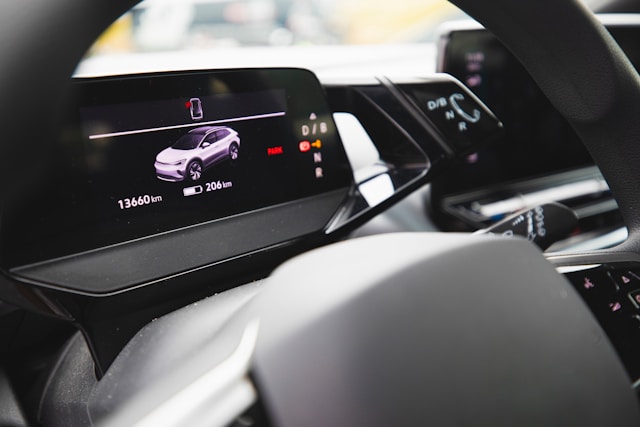
To protect the climate in the transport sector, it is important to switch from internal combustion engines to electric vehicles. However, this transition has stalled. This raises the question: are the goals of electromobility still achievable?
Sales of electric vehicles are declining.
The overall passenger car market has shrunk due to the rapid rise in the cost of living and the current political uncertainty. Sales of electric vehicles have also fallen significantly. While a total of 524,219 fully electric vehicles (FEVs) were registered in 2023, the number was only 380,609 in 2024.
A small ray of hope: in January 2025, the number of registrations increased by +53.5% compared to the same month of the previous year. With 34,498 units, PETs now accounted for 16.6% of total registrations.
The low level can also be explained by the fact that the state environmental bonus for electric cars was abolished on December 18, 2023. In order to sell a significant number of electric cars, car manufacturers are currently offering discounts.
The abolition of the purchase premium has changed the ratio of privately and commercially registered cars. While there were more private registrations than commercial ones in 2023, commercial purchases were ahead in 2024. A sales forecast for 2025 is almost impossible, as the new German federal government must first agree on the basic conditions.
The political goal of reaching 15 million electric vehicles in the light vehicle fleet by 2030 was included in the coalition agreement. Whether the new federal government will maintain this target figure remains to be seen. However, it is indisputable that the development of electromobility is the most effective measure for achieving progress in climate protection in the transport sector.
According to estimates, around 1.7 million new e-vehicles would have to be registered each year from now on. That would amount to a total of around 3 million new registrations. Selling significantly more than every second car with an electric drive seems utopian at the moment. And even if the share of electric cars sold increases only in the coming years, but at an ever-faster pace, it takes a lot of imagination to believe in 15 million.
The latest forecasts for the development of electromobility range from seven million to almost eleven million registered battery electric vehicles by 2030. The German Environment Agency (UBA) is optimistic that there will be 10.7 million electric vehicles by the end of the decade.
Is there enough green electricity?
For the transition to electromobility to yield results in climate protection, not only electric vehicles are needed, but also plenty of green electricity. Discussions about electricity generation and consumption often give rise to misunderstandings. In order for society to reach a consensus, a uniform database on electricity consumption is needed. This has been defined by the German Environment Agency (UBA).
Despite growth, the 80% target for 2030 remains very ambitious.
The good news is that the share of renewable energy sources (RES) is increasing. At the beginning of the century, it was 6.3%, and in 2010, only 17.1%, but by 2020, this share had already increased to 45.2%. In 2023, approximately 52% of electricity consumption came from renewable energy sources, and this share continues to grow. In 2024, the share is expected to be around 55% (official UBA data is not yet available).
Expansion of public charging infrastructure.
Many complain about the lack of infrastructure for electric cars, both in rural areas, along highways, and in cities. However, significant progress has been made in this area in recent years.
Nevertheless, there is still a huge gap between the current situation and the 2030 target.
Experts differ in their opinions as to whether a million charging points are needed for comprehensive coverage or whether a smaller number would suffice.
According to the German Federal Association of the Energy and Water Industry (BDEW), 100,000 to 250,000 public charging points would be sufficient in 2030. In its calculations, the National Platform for the Future of Mobility concluded that 107,000 to 631,000 charging points would be needed. In turn, the National Charging Infrastructure Management Center has calculated in its latest study that between 380,000 and 680,000 publicly accessible charging points will be needed. Ideally, 55,000 to 90,000 of these should be HPC charging points with a charging capacity of over 150 kW.
Therefore, according to expert estimates, the political goal of reaching one million does not always have to be achieved. In addition, it should be noted that the number of charging points in homes and businesses has an impact on the necessary public charging infrastructure. The more people charge at home or at work, the less they charge at public charging stations. And public charging stations must be economically viable for their operators.
For electric cars to become popular among customers, good coverage and fast charging options for travel are needed. Today, with careful planning and the use of an electric car suitable for long distances, it is possible to cope well with trips on motorways. However, the situation in cities, municipalities, and rural areas is still quite poor. Here, people are mainly dependent on wall boxes installed at home and (if possible) charging at work.
Electric car costs.
The success of electric cars among the general public is mainly determined by their cost. The biggest drawback is the higher purchase price compared to cars with internal combustion engines. On average, electric cars are much more expensive than cars with gasoline or diesel engines of the same make or model series.
When looking at the total cost, electric cars are basically no better or worse than cars with internal combustion engines. The specific model is important here, but so are fuel price and charging cost trends, which may vary depending on individual circumstances. For those who only charge at public charging stations, the costs are significantly higher than for those who charge at their home charging station. Electric cars become particularly attractive in terms of cost if the electricity used comes from your own PV system. This is beneficial for both the environment and the consumer.
Is there hope for improvement?
Opinions on electric cars vary widely. While some claim that electric cars will never be able to compete with cars with internal combustion engines, many experienced electric car users say they would never drive a car with an internal combustion engine again. These are extreme positions.
What needs to be done to make electric mobility a success in Germany, even among skeptics? Is it conceivable that there will be a turning point when, as in the case of smartphones, customers will choose electric cars offered by manufacturers en masse? Will the internal combustion engine, as an outdated and technologically backward technology, eventually disappear, as happened with “unmodern” mobile phones or analog cameras?
There are several trends and good reasons that will give impetus to the topic of electric vehicles in the coming years:
- Batteries are getting better: modern batteries provide a longer range and shorter charging times.
- Public charging infrastructure is developing: to make charging electric cars easier and more convenient, investments are being made in charging stations. These are being installed along highways, in urban areas, and in public places such as shopping centers and parking lots. Car manufacturers are also building their own networks. Porsche, Audi, and Mercedes are following Tesla’s example.
- The range of models on offer is growing: car manufacturers have significantly increased their production of electric cars and are constantly launching new models on the market. Cheaper models costing less than €25,000 are also increasingly appearing on the market.
- Purchase prices are falling: the prices of electric cars and batteries are falling, making them more accessible to a wider section of the public.
- The popularity of electric cars is growing: in recent years, public attitudes towards electric cars have improved significantly. More and more consumers are recognizing the advantages of electric cars, including low operating costs, reduced environmental impact, and high driving comfort.
Conclusion:
In 2023, transport (as a whole) caused CO₂ emissions equivalent to approximately 146 million tons. This is about 13 million tons more than politicians had set as a target for this sector. And while the energy, industry, and building sectors have met (or exceeded) their targets, the transport sector is the only one that has fallen significantly short. And if measures are not taken soon to promote electromobility, it will likely fall even further behind. It is important that electric cars have cost advantages in operation. Low charging prices are essential here. Politicians and industry agree that a large-scale reduction in electricity taxes would be a good idea.


Leave a Reply
You must be logged in to post a comment.